
Page
Create resourse-page
To create a new resource, on the Resources page, click the Add button and select the resource type - Page:
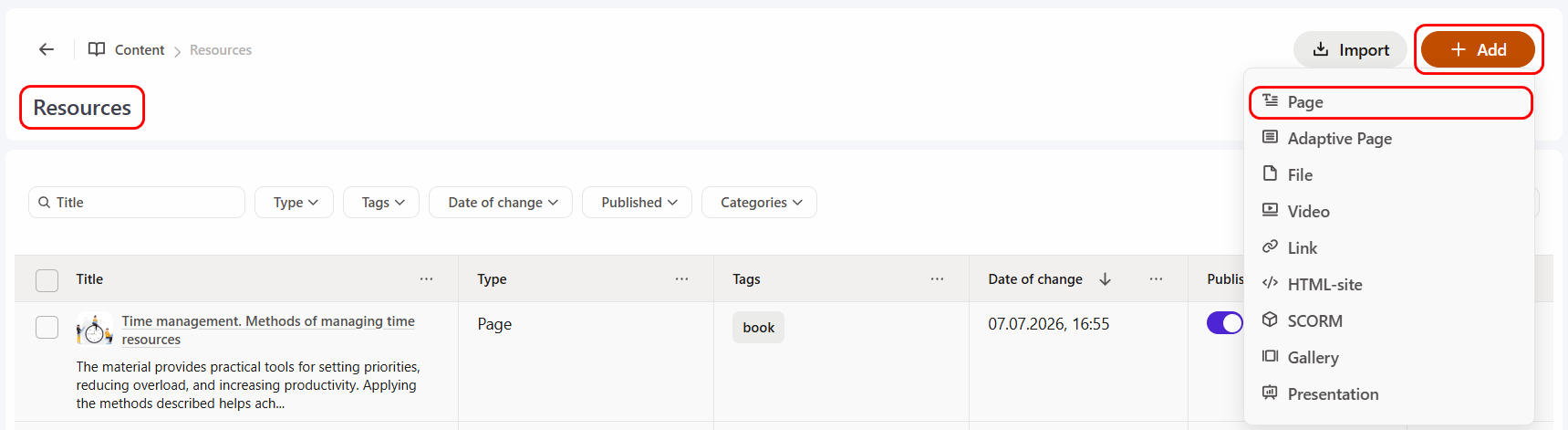
After that, the new resource creation page will open:
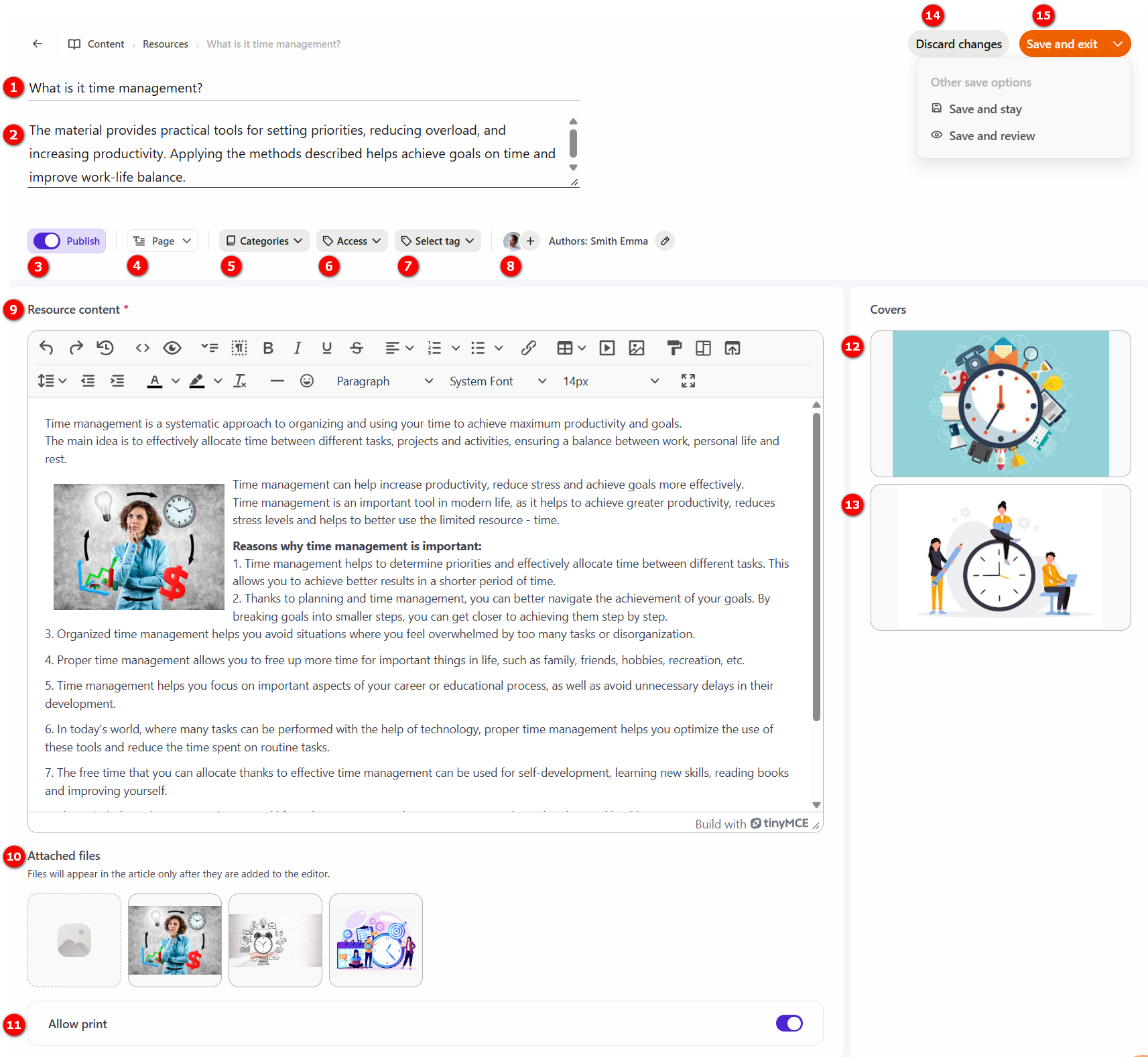
The following fields and settings are available for each resource:
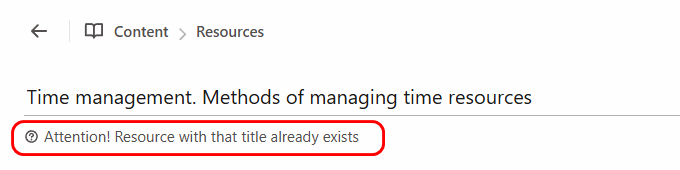
(1) - Title – the name of the resource. It is recommended to use short and understandable names. The field is mandatory.
(2) - Description – brief information about the Resource, which is displayed in the table with resources. The description can use emoticons and the
tag to jump to a new feed;
(3) - Publish - by default, publication is disabled. Only published resources can be used in the Knowledge Base and for creating tasks.
(4) - Type – Page.
(5) - Categories - the ability to assign a resource to one or more categories in the Knowledge Base. To add a resource to a category, select the checkboxes for the desired categories in the drop-down list.
If the desired category is not in the list, you can create it by clicking the Create a new category button. More details: Resource Categories;

(6) - Access -defines the users to whom the resource in the Knowledge Base will be accessible. To do this, the resource must be added to one or more previously created access groups.
If the desired access group is not among the already created groups, you can create it by clicking the Create a new access group button. More details: Knowledge Base Management.

(7) - Select tag - зif necessary, set a tag for the resource. You can select a tag from the already created ones in the drop-down list or by searching. More details: Tag management.
(8) - Authors by default, the user who created the resource is displayed. If necessary, you can change the author or add co-authors. More details: Content authors and co-authors
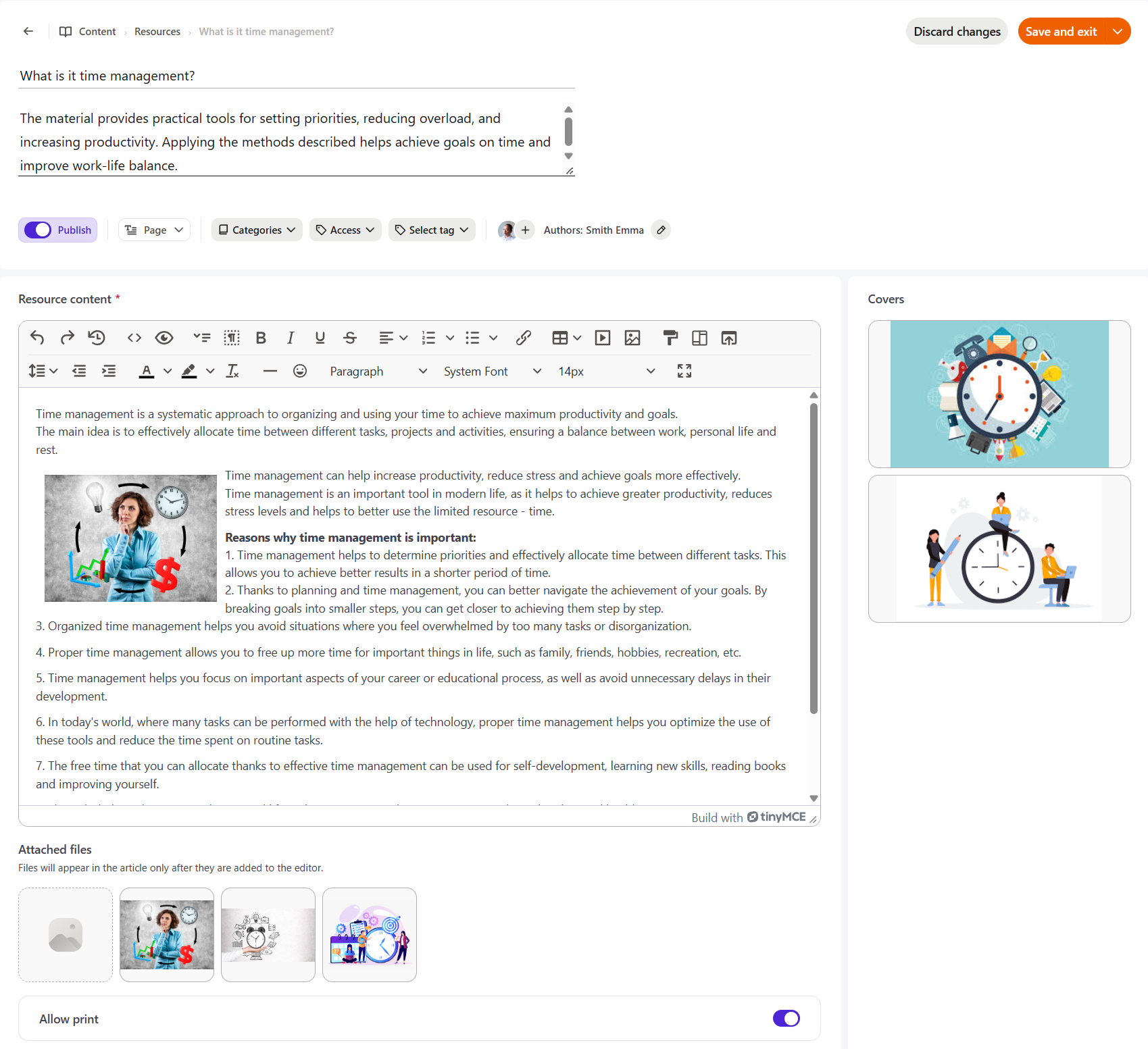
(9) - Resource content - the main content of the resource. The built-in TinyMCE editor is used to create and edit text content. It allows you to format text, add tables, links, videos, templates, and other media files, which allows you to create information materials of any complexity.
(10) - Attached files - the ability to upload files that can be added to the resource content.
(11) - Allow print - if the setting is enabled, a Print button is available to the user when viewing a resource in the Knowledge Base and when completing a task.
(12) - Resource cover - the ability to upload a cover image instead of the standard one.
(13) - Image for task card - the ability to upload a cover image for the task-resource instead of the standard one.
(14) - Discard changes - cancels changes that have not yet been saved. After clicking the "Save" button, it is impossible to cancel changes using this button.
(15) - Save and exit – save changes and navigate to the Resource table page, this button is displayed by default.
The following actions are also available:
- Save and stay – save changes and remain on the resource editing page;
- Save and preview – save changes and navigate to the resource Preview page.
The system remembers the last option selected for the "Save" button and automatically displays it the next time the page is opened.
Inserting a video from YouTube or another website using embed code
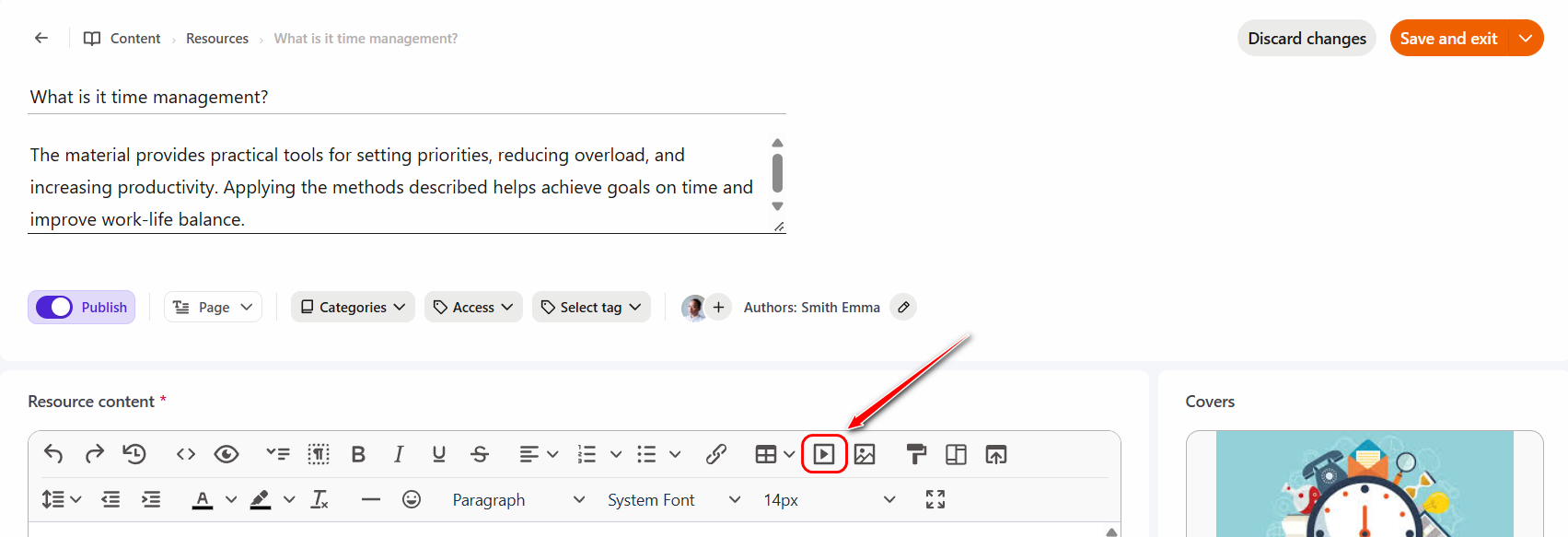
To insert a video from Youtube or another site, click the Insert/Edit Media button:
In the modal window that opens, paste the frame code from Youtube or another site:
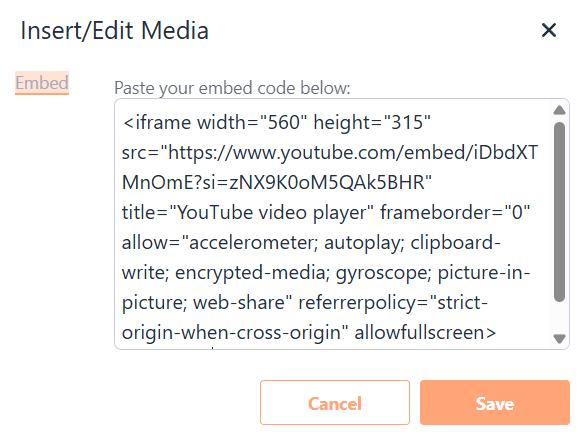
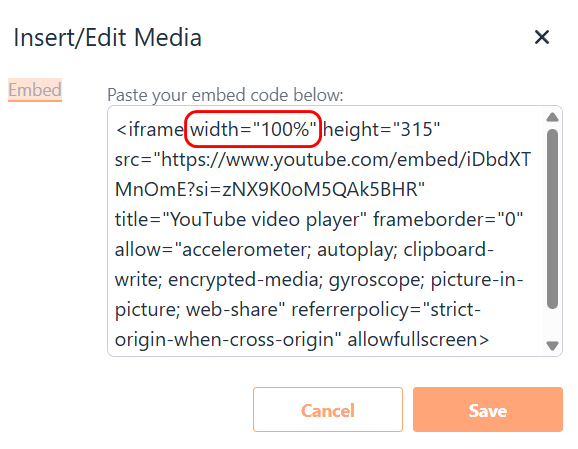
In order for the video to display correctly on all types of screens, you need to change the frame width parameter to width="100%"
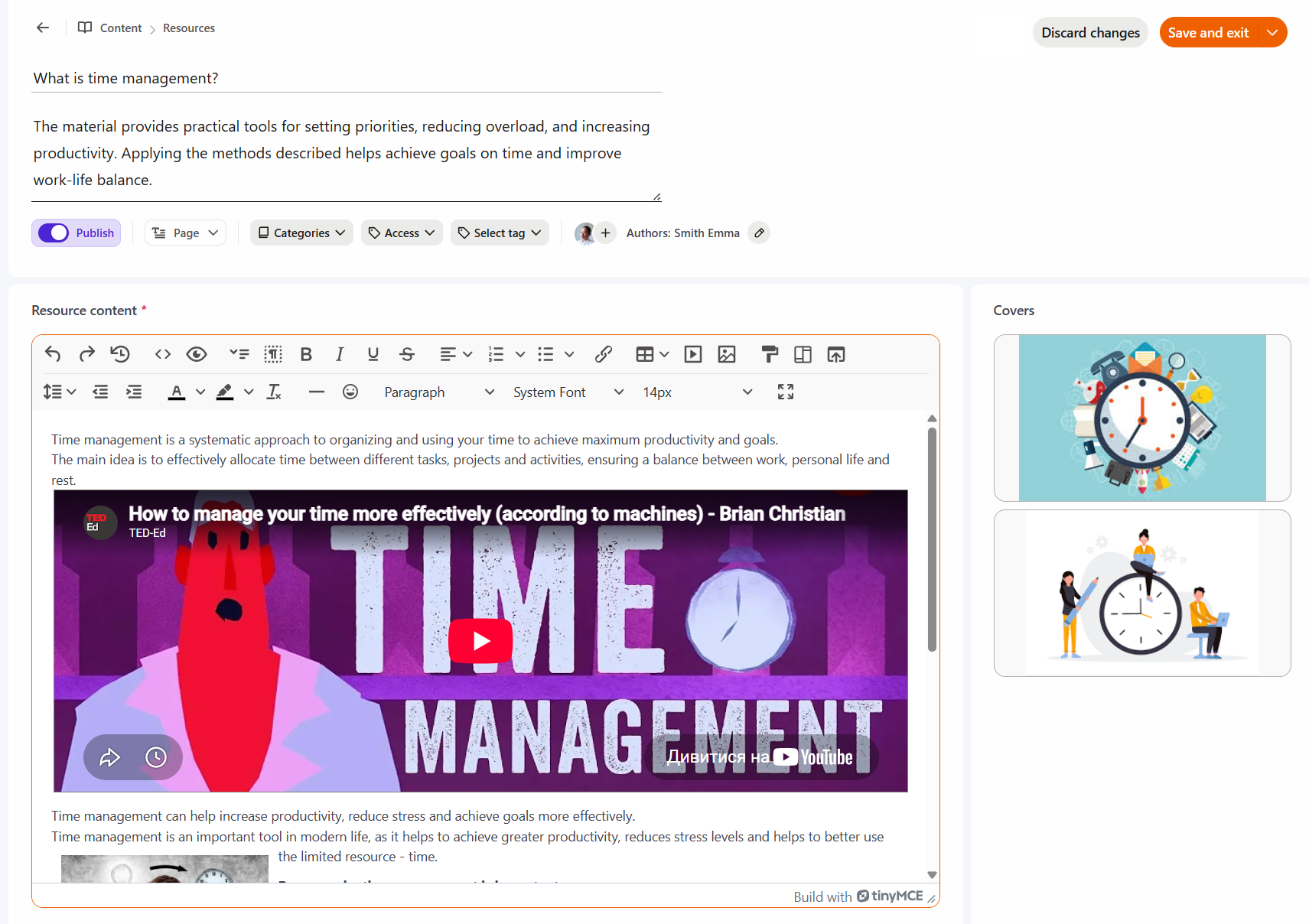
This is what a video fragment from Youtube added to the resource content will look like:
Inserting resources created in the system
When creating or editing a page resource, you can insert other resources that have already been created in the system into its content. The following types of resources are available for insertion: Gallery, Video, Audio, and HTML-site.
To insert an existing resource, click the Select Resource button in the editor.
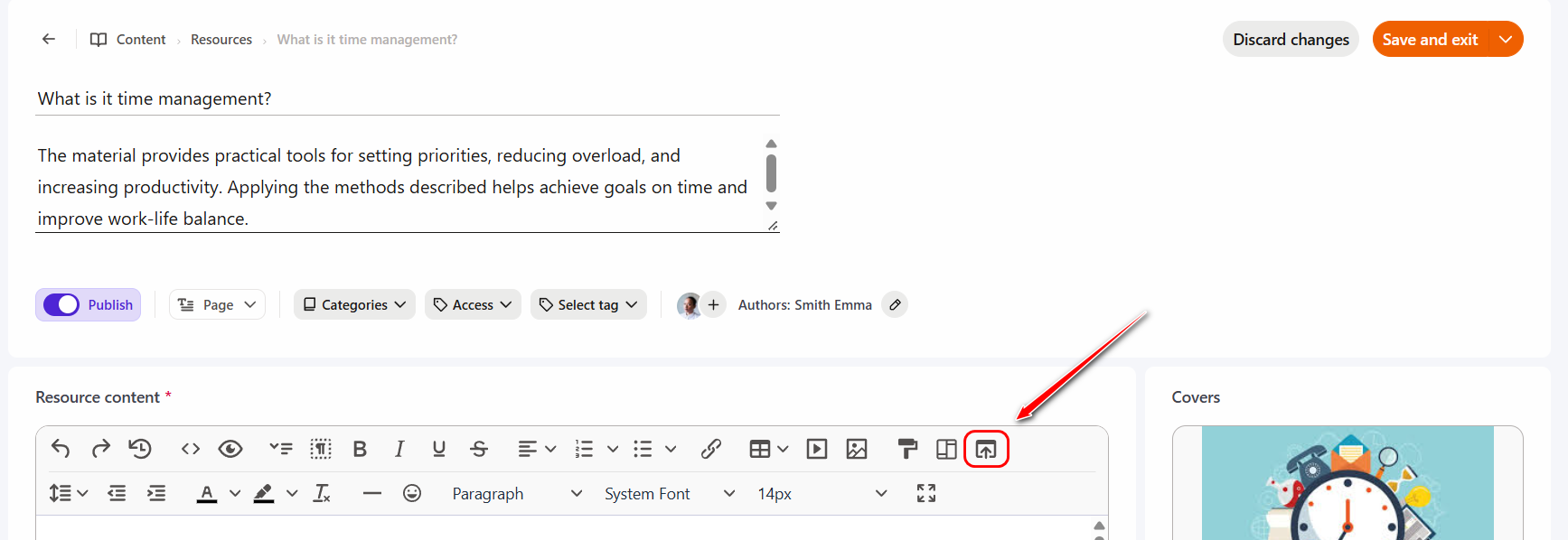
After that, a modal window will open with a list of all published resources of the type Gallery, Video, Audio and HTML-site.
To search for the necessary resource, you can use the tabs by type of resource (1) or enter its name in the search field (2).
To add the necessary resource, mark it with a marker (3) and click the Insert button (4).
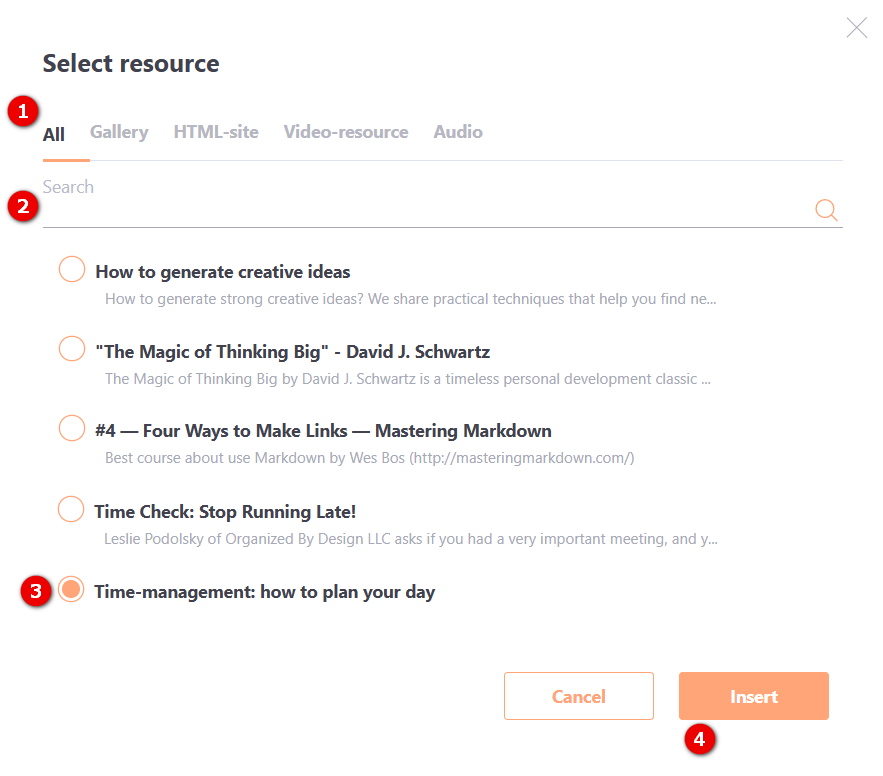
The resource will then be added to the page content at the cursor location.
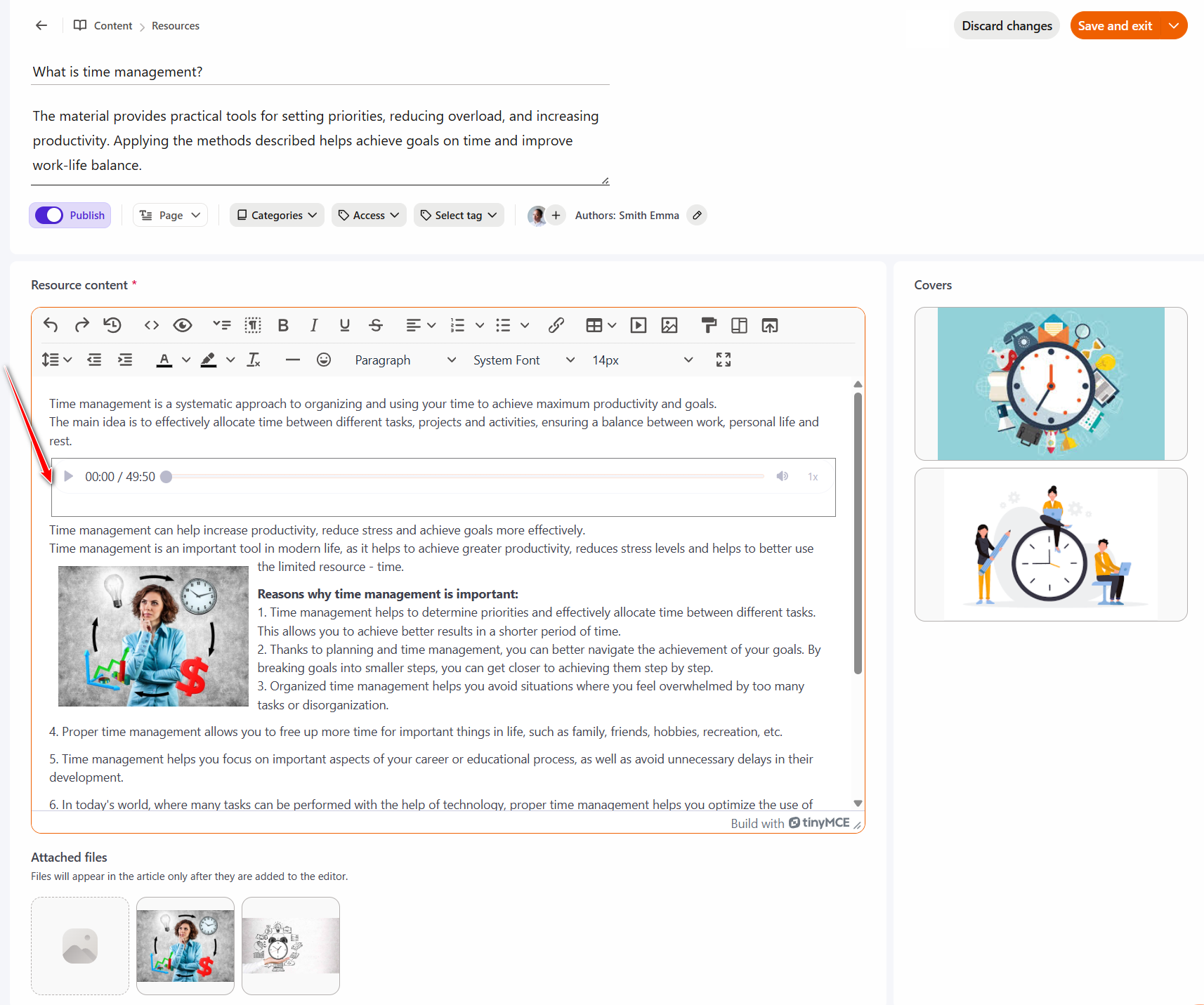
Inserting images
To add images to the content of the resource, you need first upload them via Attached files.
To insert already uploaded images, click the Select image button in the editor:
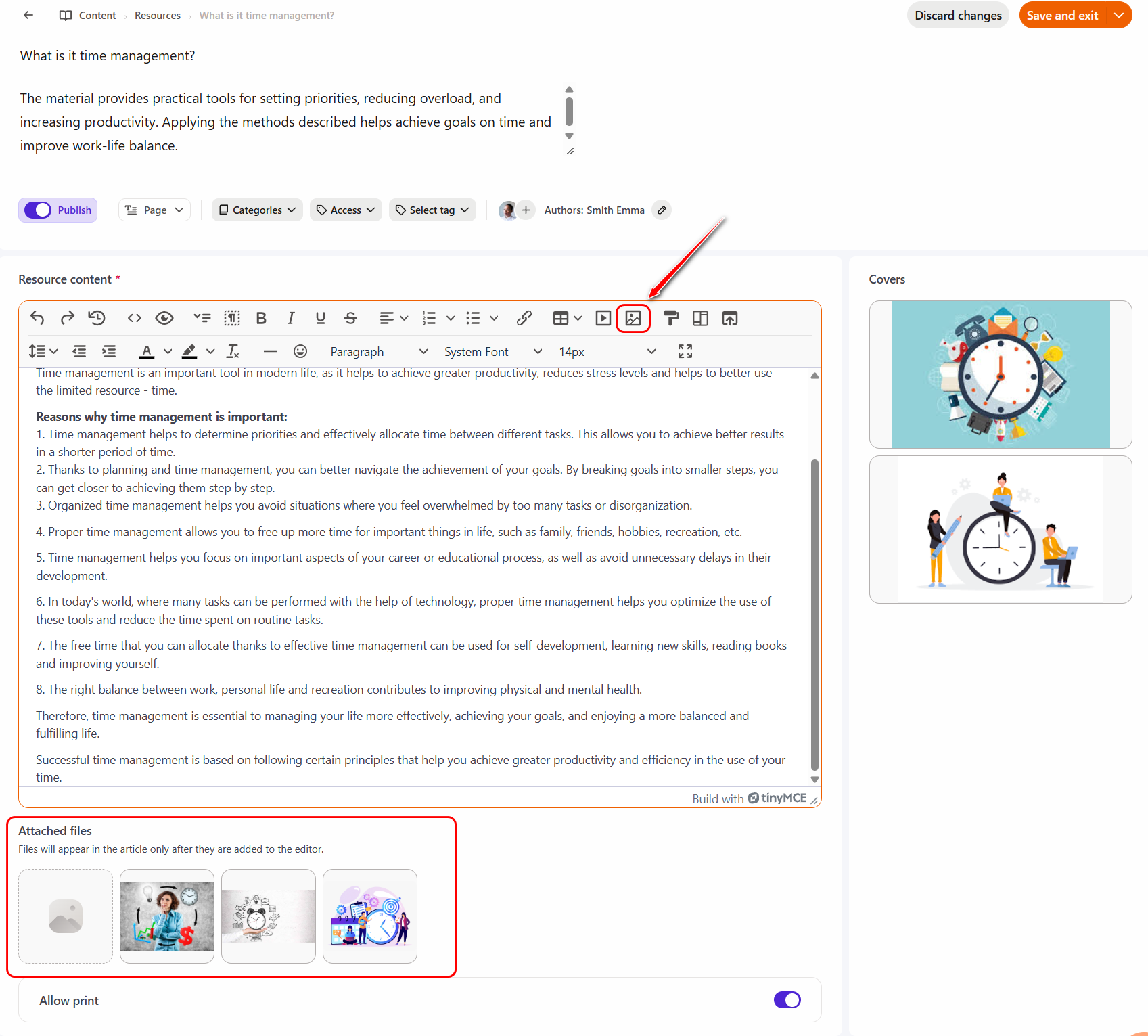
A modal window will then open displaying the uploaded images. Select the desired image and click the Insert button.
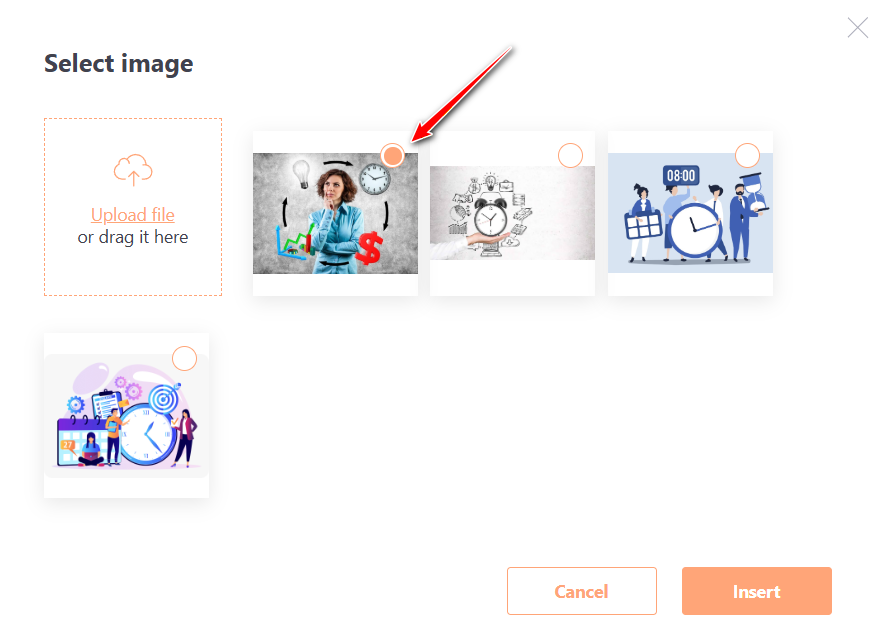
The image will be added to the Resource Content at the cursor location:
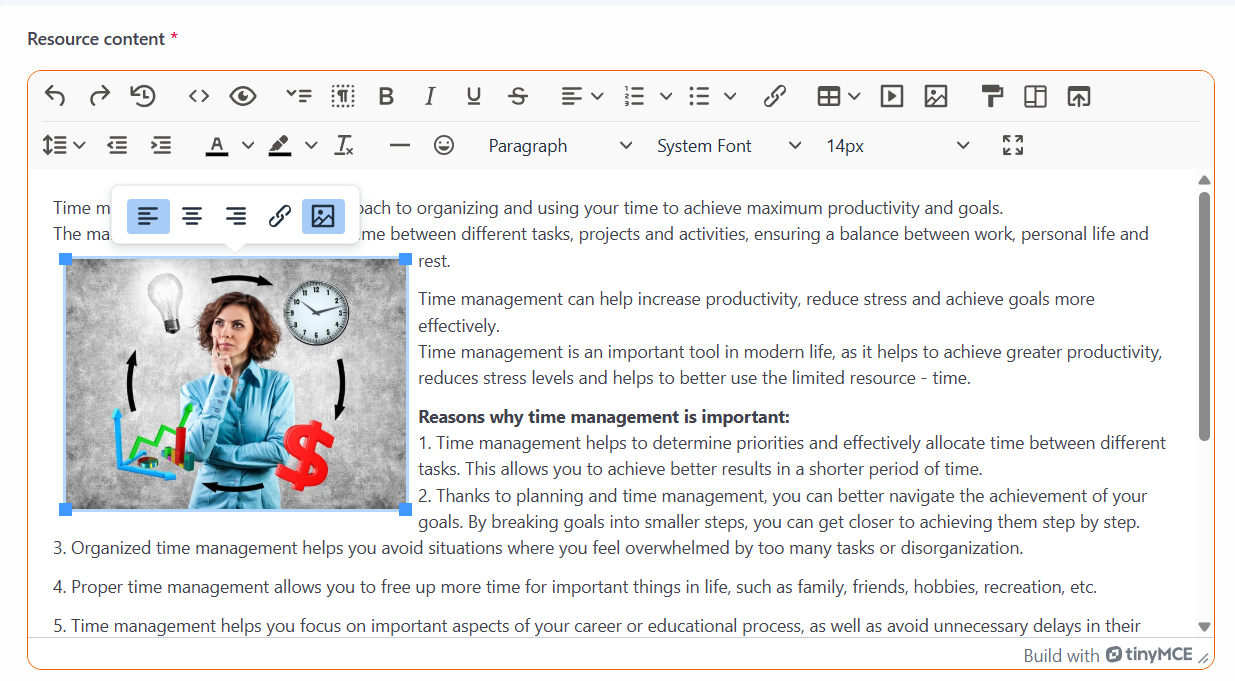
To change the image settings, click on it in the Content text. This will display a frame around the image that you can use to resize it, as well as a toolbar with buttons for left, center, or right alignment.
You can use the Insert/Edit Link button to make the image clickable (i.e., turn it into a hyperlink so that when clicked, it opens another web page).
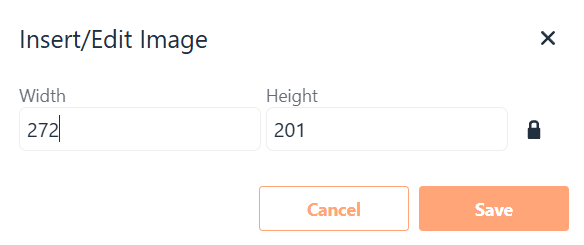
When you click the Insert/Edit Image button, a modal window opens where you can change the width and height of the image, and enable or disable the Maintain aspect ratio option to resize without distorting the image.
Inserting links
To add an active link to a resource page, simply insert it directly into the text of the document; it will be highlighted in orange.
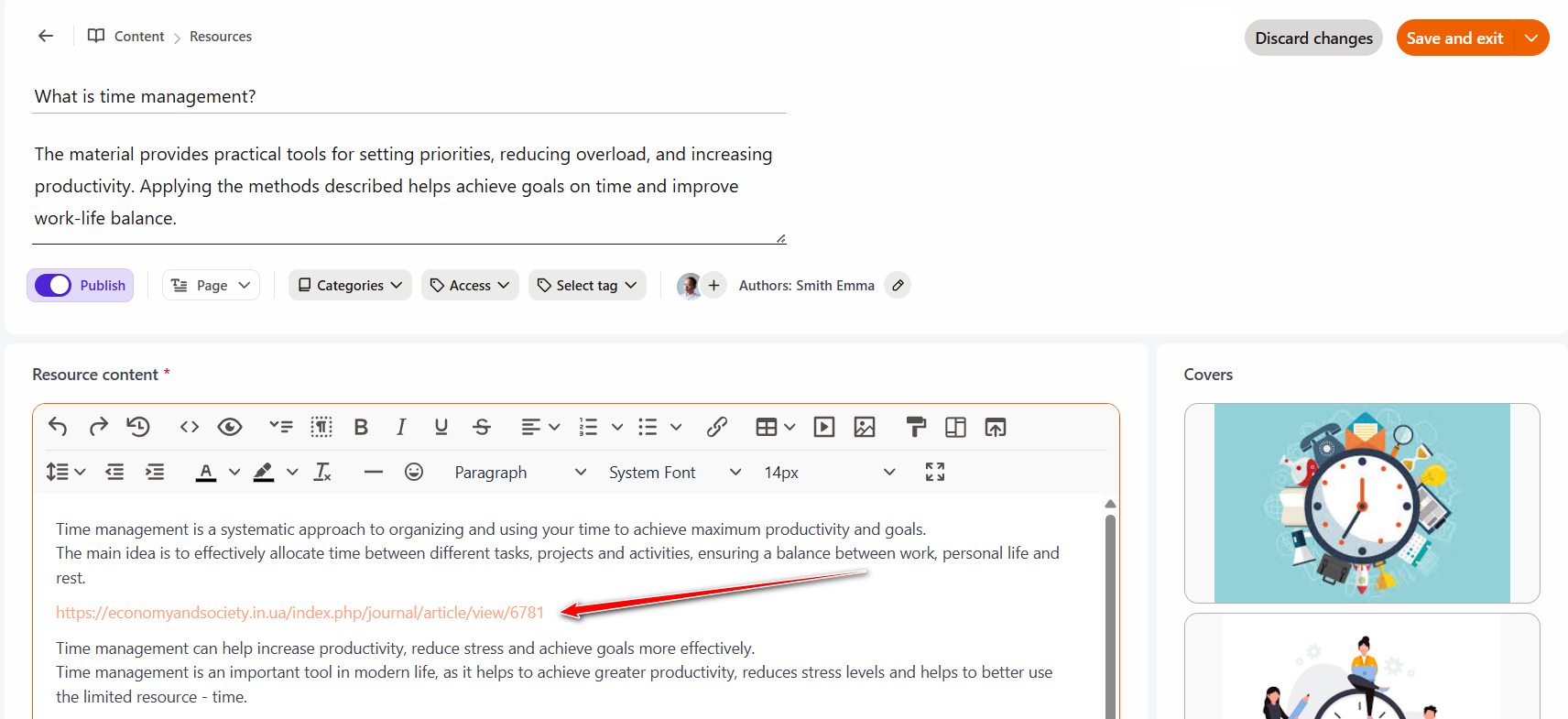
To go to the link editing menu, you need to select the link and click the "Insert/edit link" button:
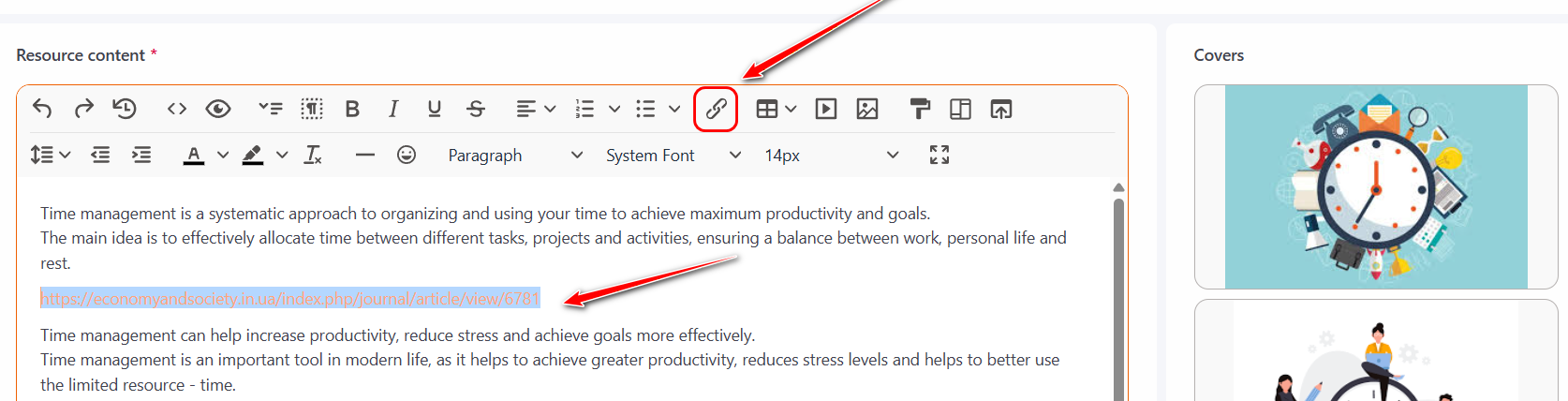
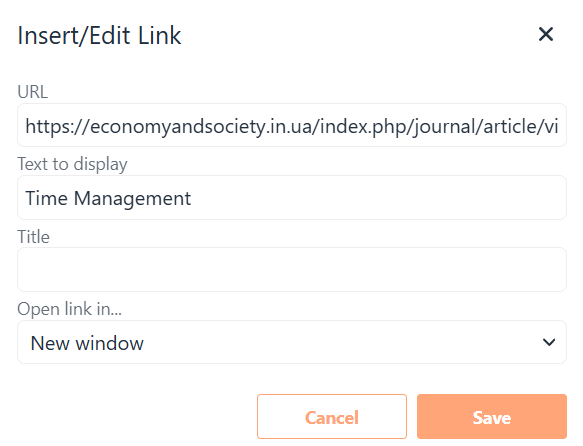
In the modal window that opens, you can:
- Edit the link address;
- Add text to display instead of the link symbols themselves;
- Add a title;
- Choose the method of opening link in:
- "-" - in the current tab
- "New window" - in a new tab, the current one will not be closed.
Inserting and working with Accordion
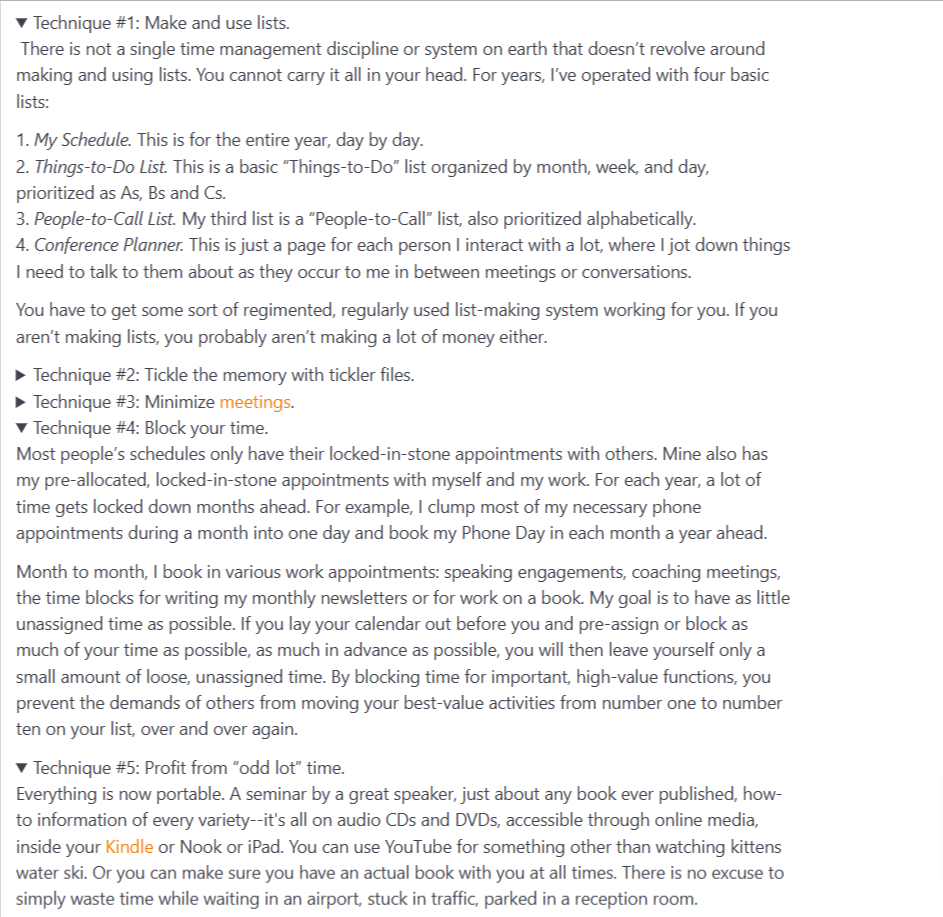
An accordion menu allows you to create sections in a document that can be expanded or collapsed to show or hide additional content.
To add an accordion menu to the text of a page resource, click the Insert accordion button in the text editor:
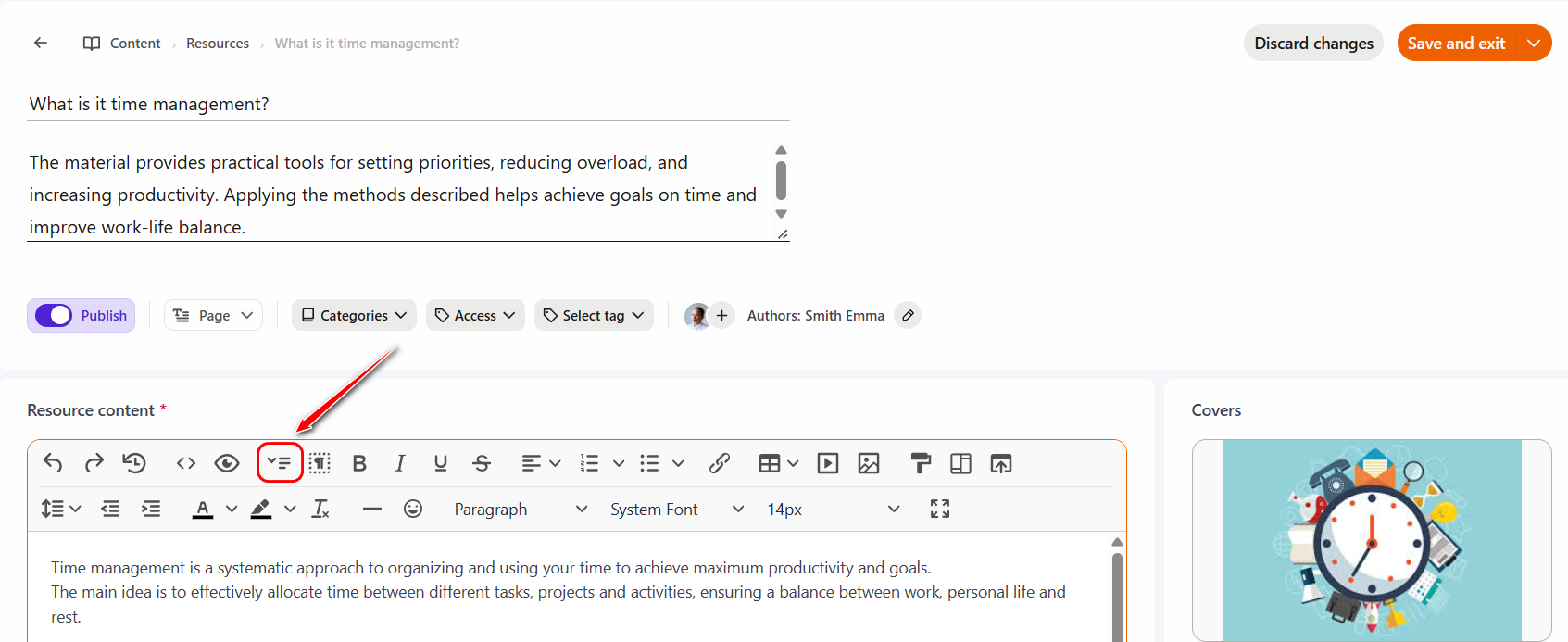
After clicking the button, a field will appear at the cursor location where you need to specify the Accordion summary (1) and Accordion body (2):
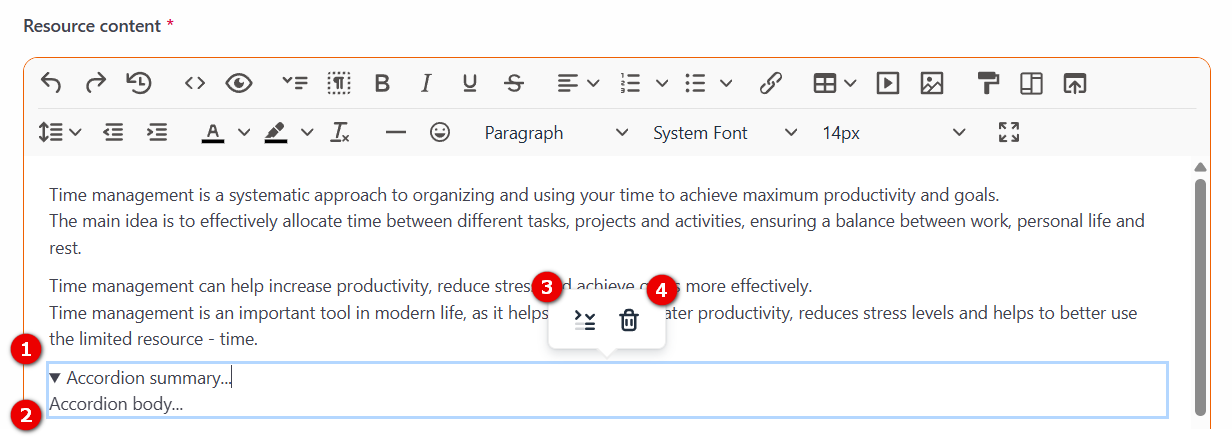
To collapse/expand the content, you need first click on the section of the inserted accordion menu to display the control buttons, and then click the button (3).
To remove the accordion menu, click the button (4).
You can insert any content into the Accordion menu: images, media, tables, links, etc.
Example of using the Accordion menu:
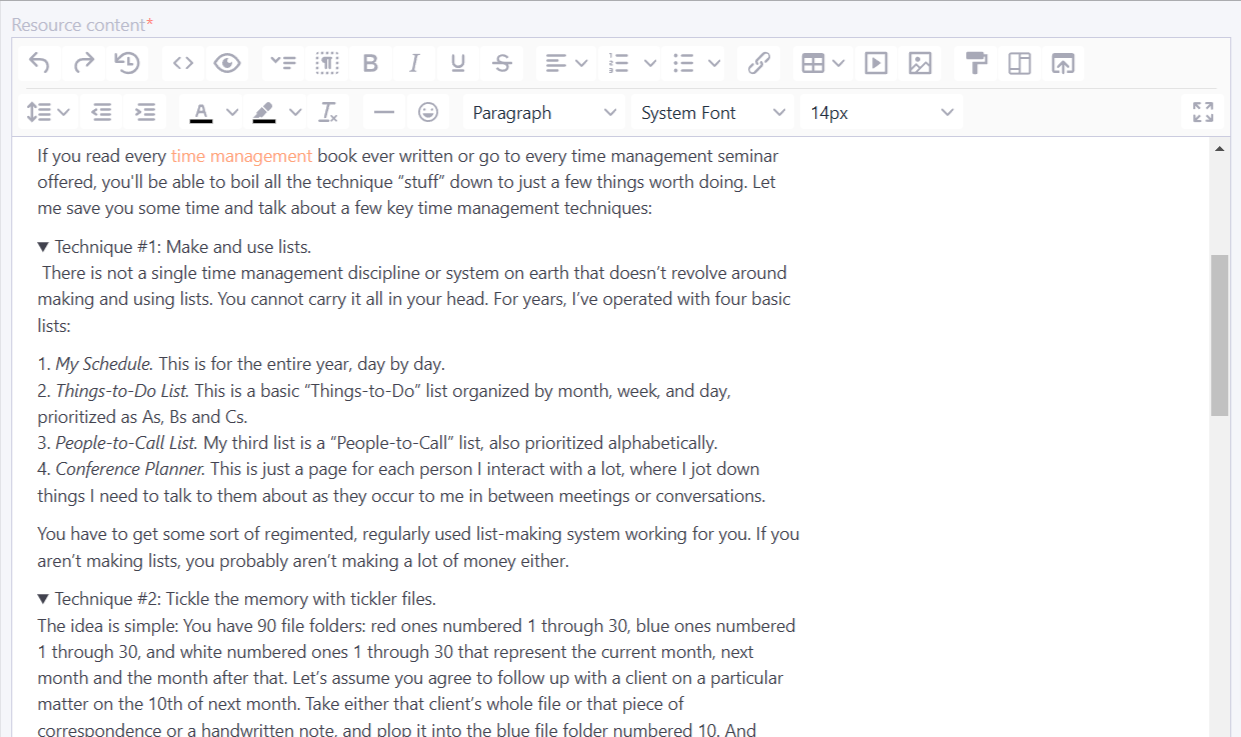
Display of the accordion when viewing the resource:
Preview
The portal administrator can view the Resource, i.e. see in advance how it will be displayed to the User.
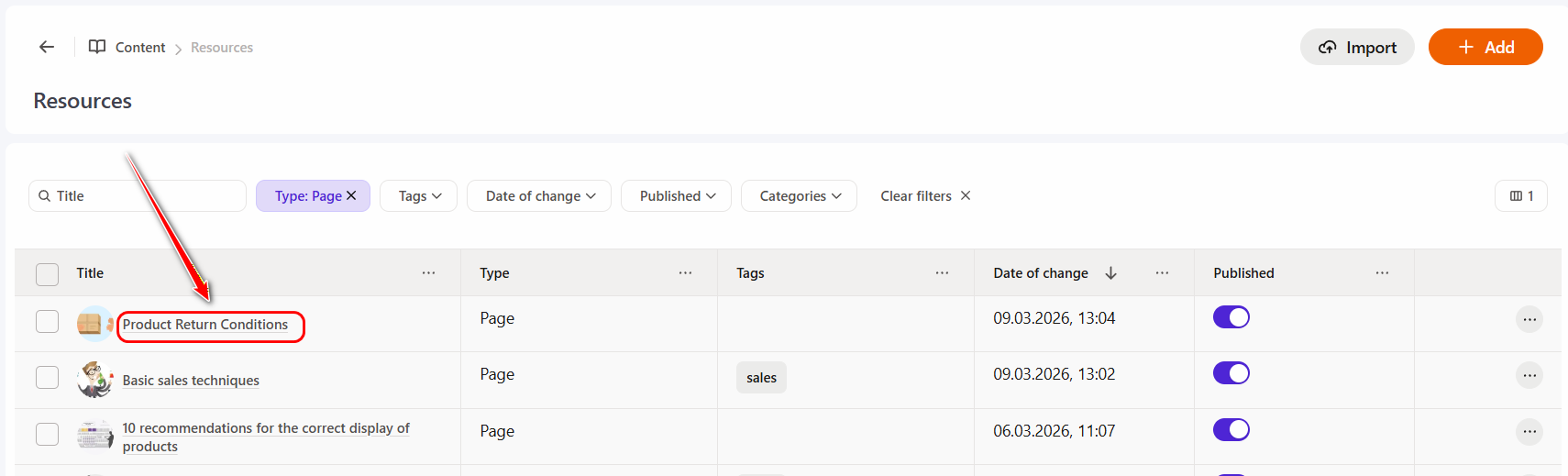
To do this, it is enough to click on the name of the Resource in the resource table (menu: Content - Resources).
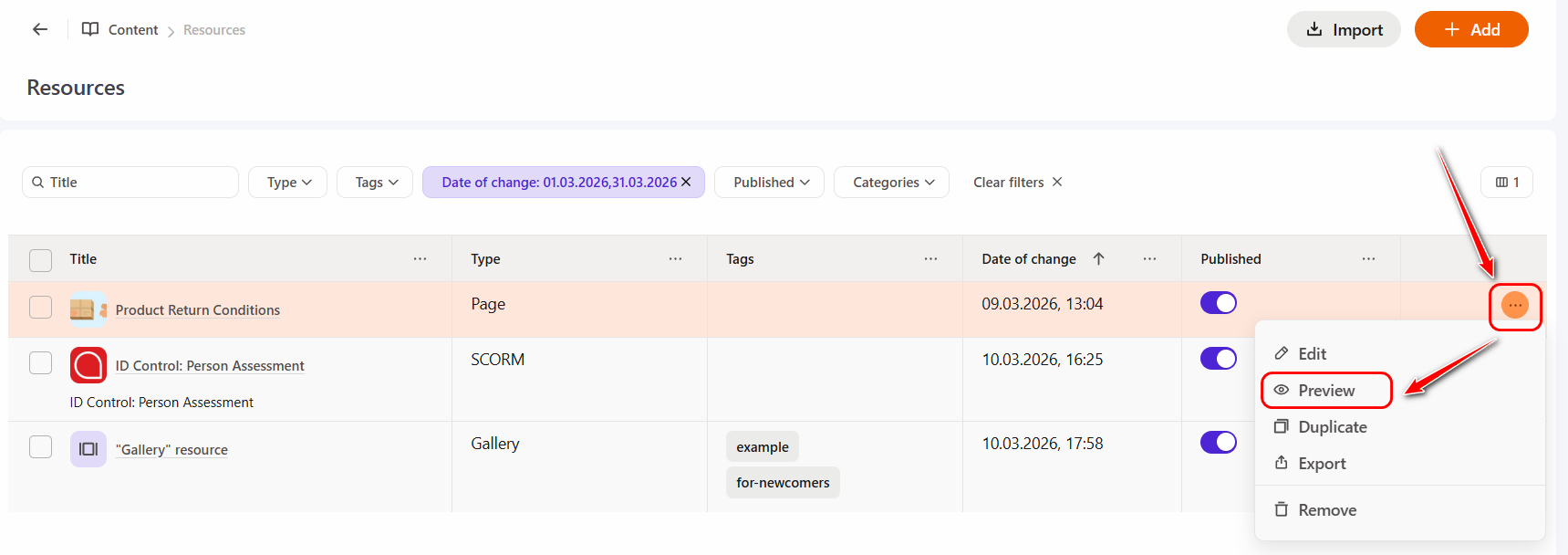
Or in the table with resources, click the Actions button Preview opposite the desired resource:
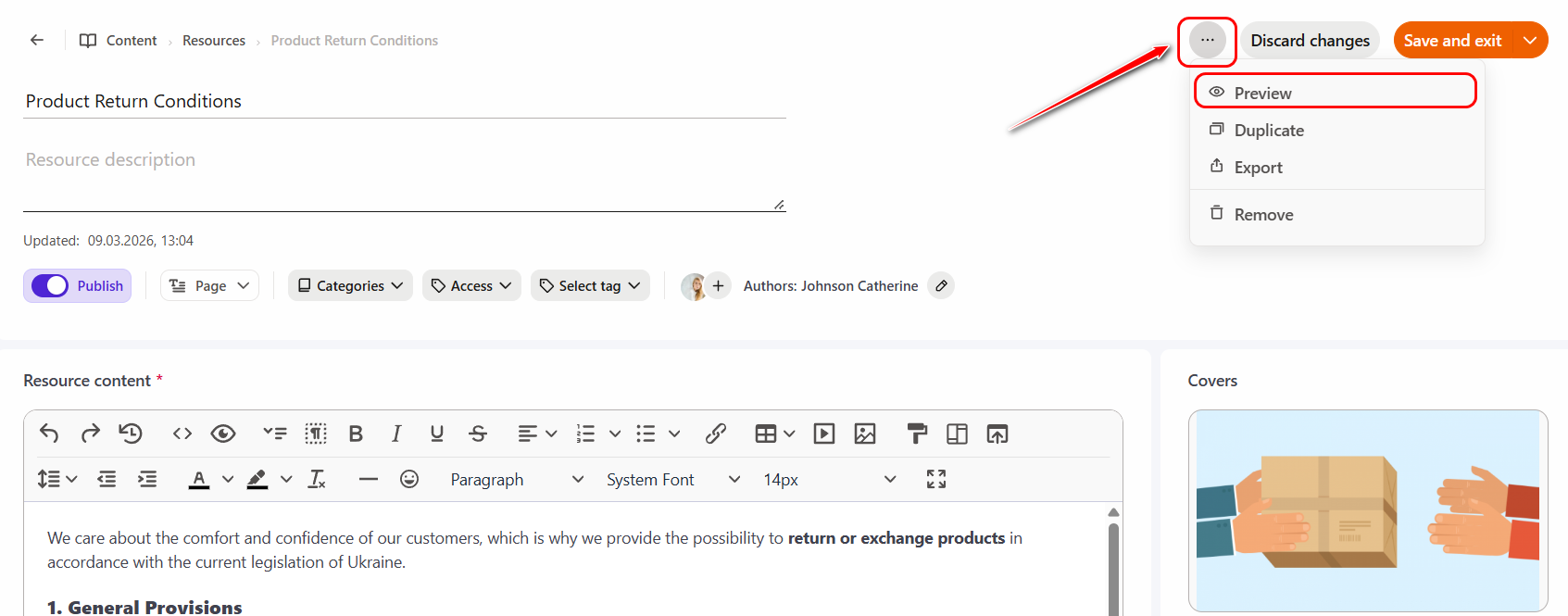
Also, after saving the resource, you can preview it from the Create/Edit resource page. To do this, click the Actions button - Preview :
Resource preview page:

(1) - Resource Name
(2) - Print - displayed if the "Allow print" setting is enabled.
(3) - Edit - go to the Resource editing page.
(4) -About resource: Updated, Author, Category, Tags.
(5) - Full screen mode - the ability to view the contents of the Resource in full screen. (The button is not displayed for very short resources, with a height of less than 200px).